
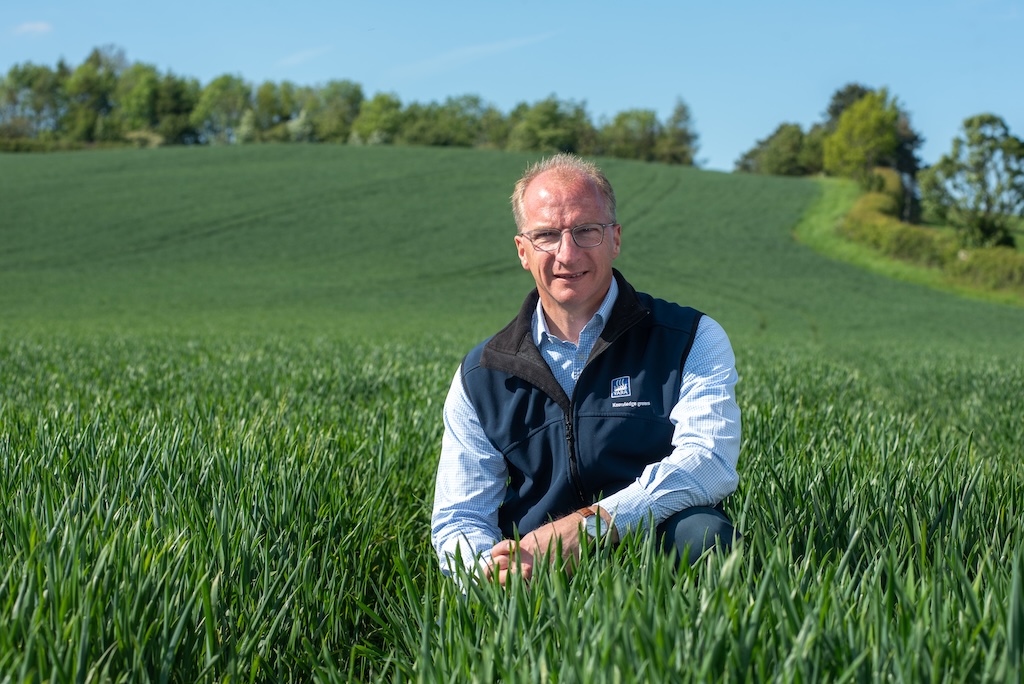
Soil health is one of farming’s biggest talking points, with declining organic matter often blamed on modern systems and years of artificial fertiliser use, especially nitrogen. But Mark Tucker, agronomist and Yara’s Food Chain Business Manager for Europe, argues that nitrogen and soil health should be seen as complementary, not competing.
Soil health, he says, combines chemical fertility, physical structure and biological activity. While fertiliser may once have been over-used, UK inputs have fallen sharply over 40 years: nitrogen use has roughly halved, phosphate is down 75%, and potassium is 66% lower than in the 1980s. “It’s a much more complex system than pinning the blame on one input,” he says.
Instead, Mark believes historic farming systems are largely responsible, particularly monoculture and continuous cereal production. Today’s renewed focus on rotations, cover crops, livestock integration and organic matter mirrors regenerative farming principles.
Manures and compost remain valuable for rebuilding organic matter, but availability is limited. The UK has lost 30% of its cattle herd, 12% of sheep and 41% of pigs, leaving less manure and uneven distribution between livestock and arable regions. Digestate, cover crops and green manures can help, but Mark stresses field-level soil analysis to target organic material where it will have most benefit. Farmers should also check the source and certification of imported materials, especially sewage-derived products.
Straw incorporation, reduced tillage and cover crops all require flexibility. Fresh organic matter can temporarily tie up nitrogen, while occasional ploughing may still be needed on some soils without undermining progress. Cover crops are especially useful after poor yields, when surplus nitrogen risks leaching.
Mark’s message is that fertiliser is not the enemy of soil health. Used judiciously alongside practices that build organic matter, nitrogen can support stronger crops, bigger root systems and better nutrient efficiency. He recommends every farm develops an integrated soil fertility plan for the next decade.
Related news:
