
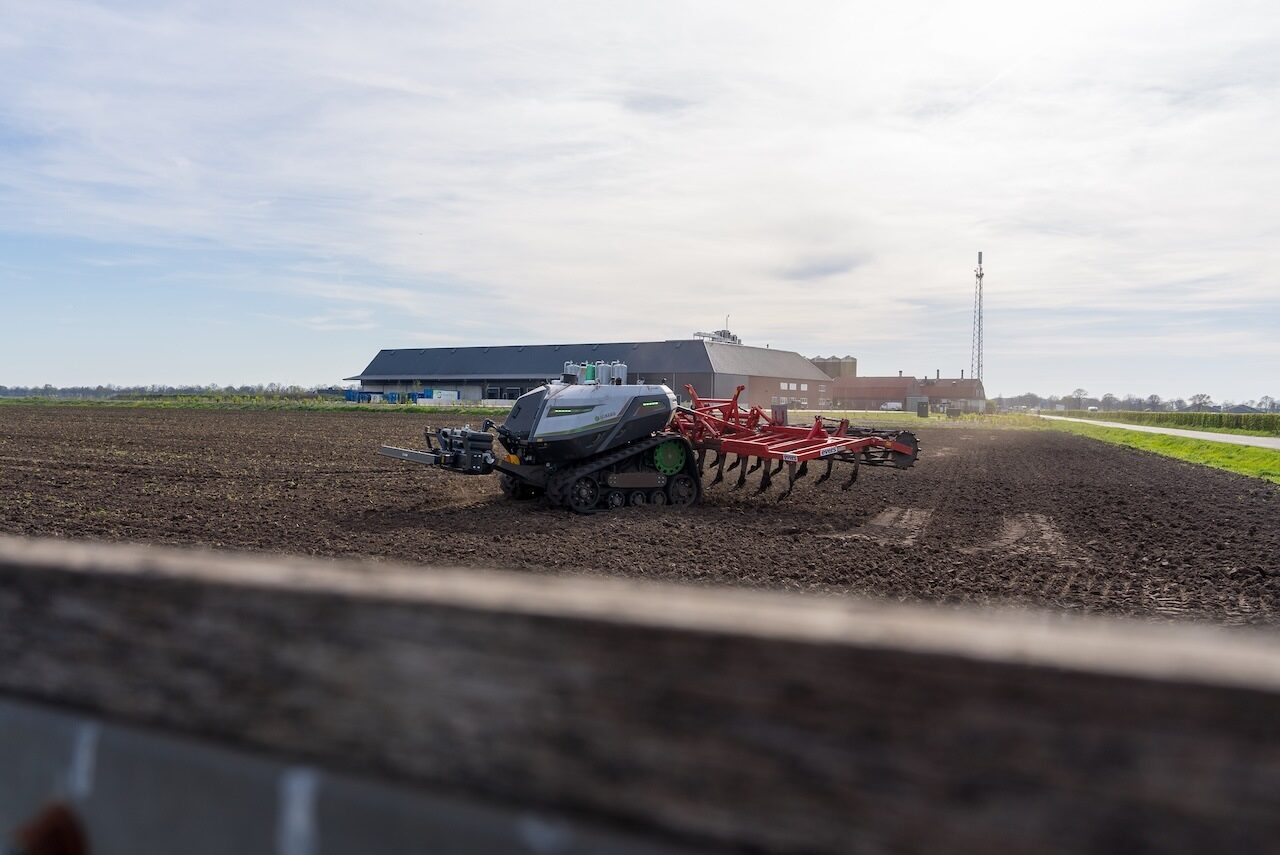
Landgoed de Princepeel says job planning through AgXeed’s TraXwise platform and remote oversight are central to how it expects the tracked, diesel‑electric AgBot to fit into 500ha of arable operations.
Landgoed de Princepeel has commissioned the first AgXeed AgBot T2 7‑Series, marking an early on-farm deployment of a driverless power unit intended to complete routine arable fieldwork from a pre-planned digital job file rather than a cab seat.
Commissioned at the end of March, the tracked machine is designed to run set routes while an operator defines field boundaries, working lines and task parameters in AgXeed’s TraXwise planning platform, then monitors progress remotely. The estate says the approach is aimed at improving machinery utilisation and making fieldwork easier to schedule in tight weather windows, while also easing labour pressure.
Delivery and commissioning were carried out by LMB Rovadi (Ysselsteyn). AgXeed says autonomous operation is supported by multiple safety layers, including sensors such as cameras and lidar alongside geofencing and remote monitoring.
Rather than positioning the unit as a general-purpose tractor, the manufacturer describes the AgBot T2 as a dedicated power platform that can be paired with standard implements via linkage, hydraulics and optional PTO.
On the power side, the T2 7‑Series uses a 230hp (170kW) diesel‑electric powertrain, with a Deutz 5.2‑litre Stage V engine driving a generator. AgXeed lists maximum torque of around ±950Nm and a top travel speed of about 13.5km/h, with hydraulic capacity up to 170l/min at 210 bar and an optional mechanical PTO (1000rpm).
For farms watching autonomy closely, the practical shift is as much about workflow as hardware: more emphasis on planning, documentation and supervision, and less on driver hours. Landgoed de Princepeel also points to soil protection as a driver, with AgXeed claiming ground pressure below 30kPa and an adjustable track width of 1.5–3.2m to suit different row widths and conditions.
The estate says it expects the platform to help it run planned operations more consistently and to make better use of available working windows as spring fieldwork peaks.
Related news:
