
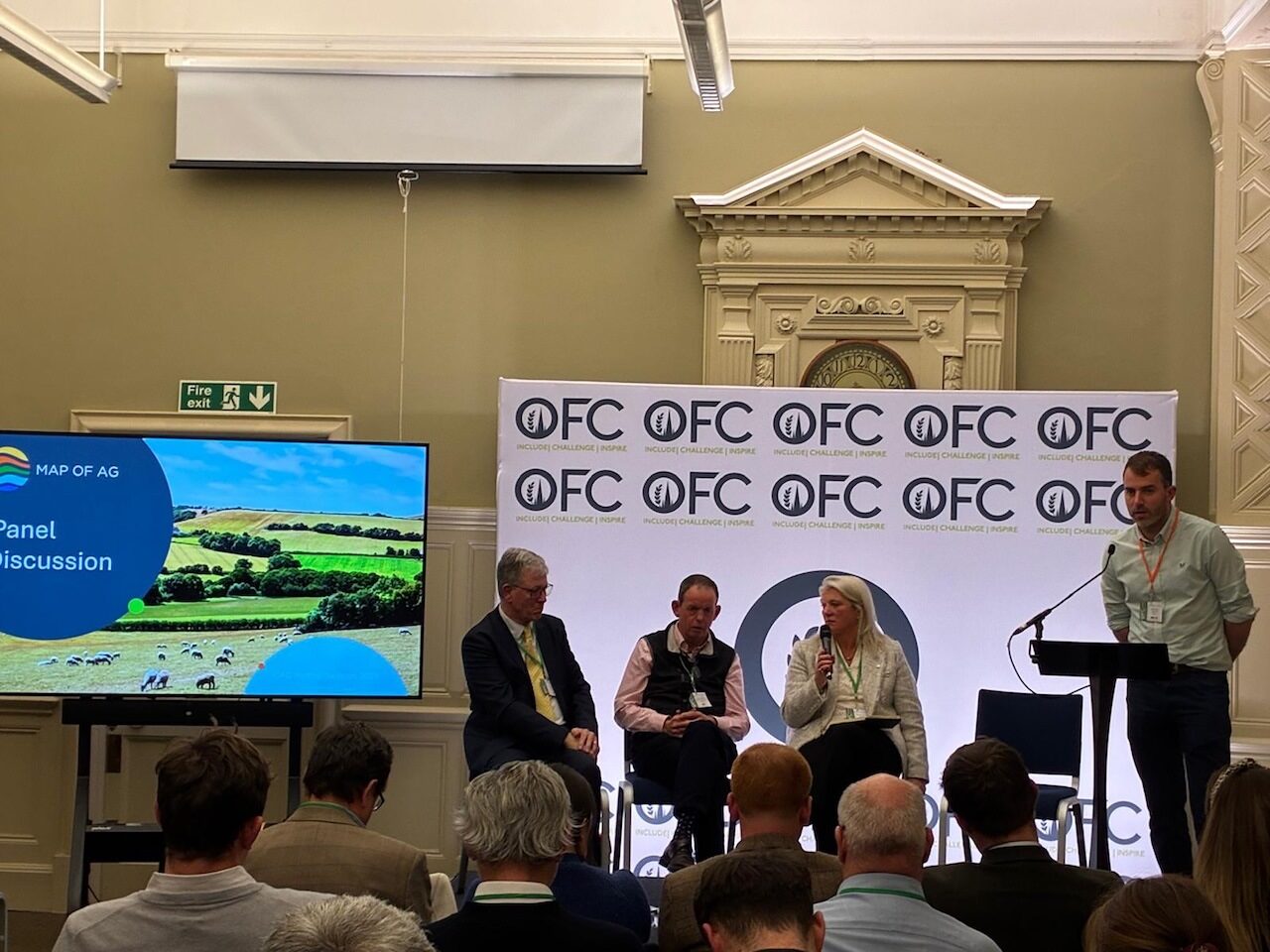
UK farm assurance is embracing technology to reduce burden, improve efficiency, and enhance confidence across the supply chain, industry leaders confirmed during a session at last month’s Oxford Farming Conference, organised and sponsored by Map of Ag.
The session, ‘Building Smarter Farm Assurance: From Review to Reality’, comes 12 months after the UK Farm Assurance Review, commissioned by AHDB and the NFU, highlighted the need for a transformational step forward in technology, data management, and collaboration.
Map of Ag’s Rob Burgess, said: “The aim of the Farm Assurance Review was to look at the whole farm assurance process, see how it delivers value to the different stakeholders such as farmers and supply chain consumers, and effectively make recommendations for how it could be improved going forwards.”
Philippa Wiltshire, Director of Standards and Operations at Red Tractor, explained how Red Tractor, which covers over 40,000 British farms, is already turning the Review’s recommendations into action by developing technology-enabled solutions to reduce duplication and audit burdens.
Red Tractor has upgraded its online filing cabinet into an efficiency tool that farmers can use year-round, not just before inspections, and is in the process of introducing innovations such as photo-based records and guidance on prioritising high-impact documents.
“We’re upgrading the Red Tractor Members Portal to make it an easier and more efficient way to stay on top of paperwork”, Mrs Wiltshire explained. “Using the portal means assessors will be able to spend less time during a farm visit looking at paperwork, reducing the length of their visit.”
She also shared details of collaboration in the dairy sector with the Tesco Sustainable Dairy Group to reduce the audit burden.
“Before, these farmers were having additional audits and separate inspectors. By working in partnership with Tesco, we were able to offer farmers the ability to be able to use our portal, to be able to upload records that they needed to for that customer, all very secure.”
Mrs Wiltshire did emphasise the need for farmers to retain full control of their data. “The data is the farmer’s data, and the farmer needs control over that data all the time. Red Tractor doesn’t see and has no access to anything the farmer puts on the portal;it’s purely the assessor.”
Providing an on-farm view, tenant dairy and beef farmer David Christensen who farms in Oxfordshire outlined the complexity of operating across multiple assurance and customer schemes, while stressing their importance to UK food credibility.
“These schemes are hugely important. They’re not universally popular sometimes with farmers, but we’ve got really good food credibility in the UK, and we need something standing behind that to justify the standards and justify the claims.”
Mr Christensen was clear that the issue is not assurance itself, but how it is delivered.
“The most exhausting part of farming today is not the farming, it’s the paperwork.”
He highlighted duplication across schemes as a major source of frustration, praising recent progress where inspections have been combined.
“Hats off to Tesco and Red Tractor for getting that together, because so much of it was overlapping, it was bonkers.”
Looking ahead, Mr Christensen suggested that the next step must be automation rather than repeated manual data entry.
“We’ve talked about only entering data once, but better for me is automatic data collection. There’s a mass of data already there in systems like BCMS, herd management software, robots and milk recording that could be picked up automatically.”
He also called for better alignment across schemes. “It drives me mad when I’m having to assess animals with a different scale for different organisations. Wherever possible, can we not align measures?”
Mr Christensen suggested that assurance could deliver greater value by combining compliance with practical support and benchmarking.
“There’s a real opportunity for looking at the data to do some benchmarking and comparing how I’m getting on.”
Phil Pearson, Development Director at APS Group, the UK’s largest tomato grower for high street stores, explained how robotics, precision breeding, and automated data collection are already being used to streamline audits and support compliance across multiple standards in that sector.
However, all speakers stressed that technology alone is not enough. Success requires collaboration across farmers, certification bodies, retailers, and policy makers, while ensuring systems remain affordable and sector appropriate.
Mrs Wiltshire added: “We’ve got to think outside the box as an industry. Don’t just think about what we could change in the next 18 months. What do we want it to look like in five years’ time, or 10 years’ time? This is about continuous change.”
Related news:
